admin

Introduction to Digital Marketing and Graphic Design

Introduction to Digital Marketing and Graphic Design In today’s fast-moving online world, digital marketing and graphic design work hand in hand to build powerful brands. Businesses no longer depend only on traditional advertising. Instead, they use online platforms, social media, search engines, and creative visuals to attract customers. Digital marketing focuses on promoting products and services through digital channels, while graphic design creates visual content that communicates messages clearly and effectively. Together, they create strong brand identity, better engagement, and higher conversions. What is Digital Marketing? Digital marketing is the promotion of brands using the internet and digital technologies. It includes search engine optimization (SEO), social media marketing, content marketing, email marketing, pay-per-click (PPC) advertising, and more. Platforms like Google and Meta play a major role in online advertising. Digital marketing helps businesses reach their target audience directly. Unlike traditional marketing, it allows companies to measure results in real time. You can track website traffic, clicks, engagement rates, and conversions. This makes it easier to adjust strategies and improve performance. Importance of Graphic Design in Marketing Graphic design is the visual language of a brand. It includes logos, posters, social media posts, website layouts, brochures, and advertisements. A well-designed visual can capture attention within seconds. In digital marketing, first impressions matter. If your visuals are not attractive, users may scroll past your content. Good graphic design builds brand recognition. Consistent colors, fonts, and style make a brand memorable. For example, companies like Apple Inc. and Nike use simple yet powerful design elements that make their branding instantly recognizable worldwide. The Connection Between Digital Marketing and Graphic Design Digital marketing strategies are incomplete without strong visuals. Whether it is a Facebook ad, Instagram post, or website banner, design plays a key role in attracting customers. Social media platforms such as Instagram and YouTube rely heavily on visual content. When digital marketers plan campaigns, graphic designers create engaging visuals that match the brand message. For example, in a product launch campaign, marketers define the target audience and goals, while designers create banners, videos, and promotional graphics that influence buying decisions Role of Social Media in Branding Social media has become one of the most powerful digital marketing tools. Businesses use it to connect directly with customers. Creative graphics increase likes, shares, and comments. Eye-catching posts stand out in crowded feeds. Platforms like LinkedIn are used for professional branding, while Instagram focuses more on visual storytelling. Graphic design helps brands maintain a professional and consistent look across all platforms. This builds trust and credibility among followers Website Design and User Experience A website is the digital face of a business. Good graphic design improves user experience (UX). Clean layouts, readable fonts, and attractive images make visitors stay longer on a website. Poor design can increase bounce rates and reduce conversions. Digital marketers optimize websites for SEO, while graphic designers ensure the site looks appealing. Together, they create a balance between functionality and beauty. A well-designed website not only attracts traffic but also converts visitors into customers Content Marketing and Visual Storytelling Content marketing involves sharing valuable information to attract and retain customers. However, plain text is often not enough. Visual elements like infographics, illustrations, and videos make content more engaging. Graphic design supports storytelling by turning complex information into easy-to-understand visuals. For example, infographics can present data in a clear and attractive format. This increases readability and shareability, boosting digital marketing results The Future of Digital Marketing and Design The future of digital marketing and graphic design is constantly evolving. Artificial intelligence, automation, and interactive design are changing how brands connect with audiences. Short-form videos, motion graphics, and personalized ads are becoming more popular. Design trends also change frequently. Minimalism, bold typography, and vibrant colors are currently in demand. Businesses must stay updated with trends to remain competitive. Digital marketers and graphic designers need to work together creatively to produce innovative campaigns. Conclusion Digital marketing and graphic design are two sides of the same coin. Digital marketing brings visibility and strategy, while graphic design brings creativity and visual impact. Without design, marketing lacks attraction. Without marketing, design lacks purpose. In today’s competitive online world, businesses must invest in both areas to build strong brands and achieve long-term success. By combining smart strategies with creative visuals, companies can attract, engage, and convert their audience effectively.

Introduction to Digital Marketing and Graphic Design Read More »
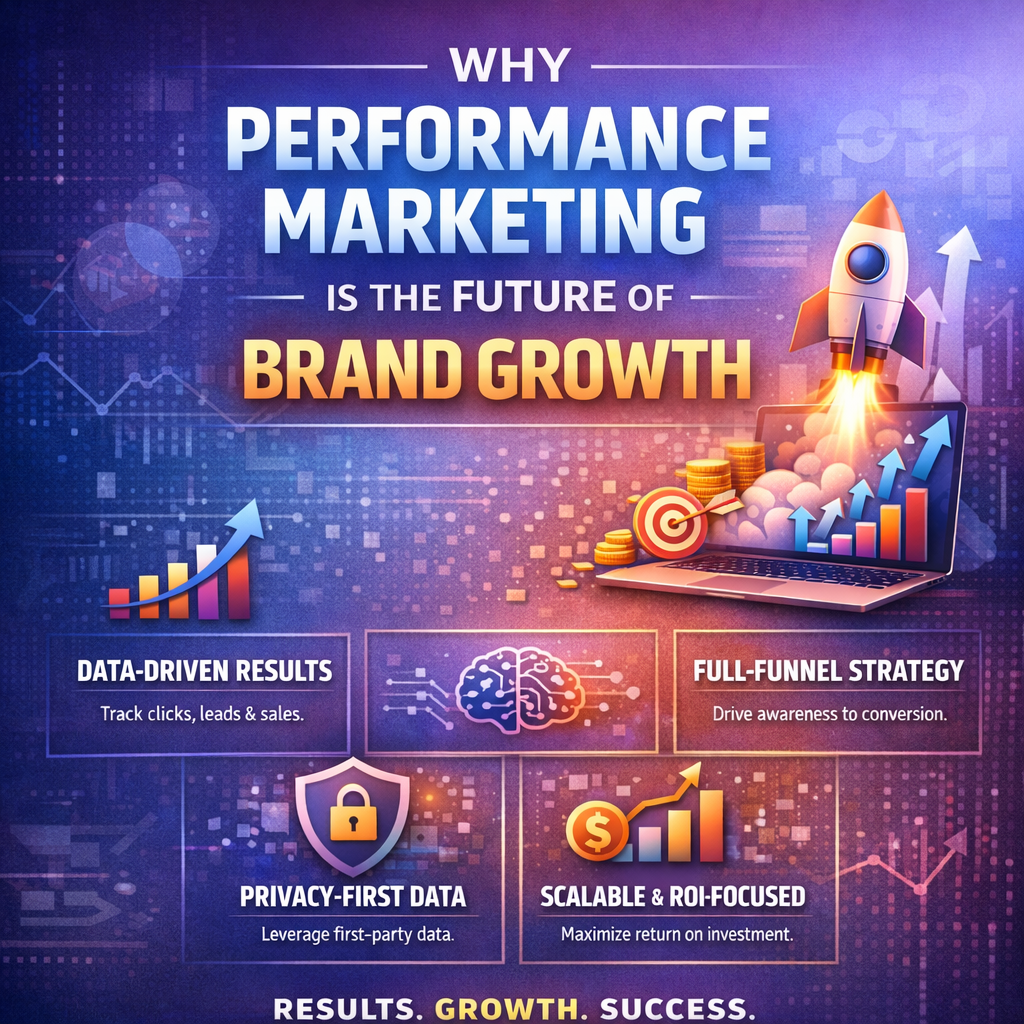
Why Performance Marketing Is the Future of Brand Growth

Why Performance Marketing Is the Future of Brand Growth Performance marketing has become one of the most powerful drivers of modern brand growth, transforming how businesses approach digital advertising and customer acquisition. Unlike traditional marketing methods that focus mainly on reach and visibility, performance marketing prioritizes measurable results such as leads, conversions, sales, and return on investment. In an era where marketing budgets are closely monitored and accountability is essential, brands are increasingly adopting performance-driven strategies to ensure every marketing effort delivers tangible business outcomes. This shift reflects a broader demand for data-backed decision-making and scalable growth models that can adapt to rapidly changing consumer behavior. What Is Performance Marketing? Performance marketing is a results-oriented digital marketing approach where brands pay for specific actions rather than just exposure. These actions may include clicks, app installs, lead submissions, or purchases. Channels such as search engine marketing, social media advertising, affiliate marketing, influencer performance campaigns, and programmatic advertising are core components of performance marketing. By focusing on measurable outcomes, performance marketing enables brands to understand exactly how their investments contribute to business growth and to optimize campaigns continuously for better results. Data-Driven Decision Making One of the strongest reasons performance marketing is shaping the future of brand growth is its reliance on data-driven insights. Every interaction can be tracked, analyzed, and optimized, giving brands complete visibility into customer behavior. Metrics such as conversion rate, cost per acquisition, return on ad spend, and lifetime value help marketers identify what is working and what needs improvement. This data-driven approach eliminates guesswork and allows brands to make informed decisions that directly impact growth. As competition increases and marketing costs rise, the ability to optimize campaigns based on real-time data becomes a significant competitive advantage. Transparency and Accountability in Marketing Performance marketing brings unmatched transparency and accountability to digital advertising. Brands can clearly see how their budgets are spent and what outcomes they generate. This transparency builds trust between stakeholders and marketing teams while enabling faster and more confident decision-making. Performance dashboards and analytics tools allow brands to monitor campaigns in real time, adjust strategies instantly, and ensure marketing spend aligns with business objectives. As a result, brands can achieve more efficient growth without unnecessary budget wastage. The Role of AI and Automation Artificial intelligence and automation have become central to the success of performance marketing. AI-powered tools analyze vast amounts of data to optimize bidding strategies, audience targeting, ad creatives, and campaign timing. Machine learning algorithms continuously learn from user behavior, enabling campaigns to adapt in real time for better performance. Automation also allows brands to scale campaigns efficiently without increasing operational complexity. As AI technology continues to advance, performance marketing will become even more precise, personalized, and effective, reinforcing its role as the future of brand growth. Personalization and Customer Experience Modern consumers expect personalized and relevant experiences, and performance marketing delivers on this expectation by leveraging data and technology. By understanding user intent, preferences, and behavior, brands can deliver tailored messages at the right time and on the right platform. Personalization not only improves conversion rates but also strengthens brand relationships and customer loyalty. Performance marketing enables brands to create meaningful interactions throughout the customer journey, turning one-time buyers into long-term customers. The Future Belongs to Performance Marketing Performance marketing is not just a trend but a fundamental shift in how brands achieve growth in the digital age. By combining measurable results, data-driven insights, AI-powered optimization, personalization, and privacy-first strategies, performance marketing provides a future-ready framework for sustainable brand success. As digital ecosystems continue to evolve, brands that embrace performance marketing will be better positioned to adapt, scale, and thrive. For businesses seeking predictable, accountable, and impactful growth, performance marketing is undeniably the future of brand growth.  

Why Performance Marketing Is the Future of Brand Growth Read More »

Specializes in AI and Machine Learning in Marketing

Specializes in AI and Machine Learning in Marketing Artificial Intelligence (AI) and Machine Learning (ML) are no longer futuristic concepts they are actively reshaping the way modern marketing works. A marketing strategy that specializes in AI and machine learning focuses on using data-driven intelligence, automation, and predictive analytics to create smarter, faster, and more personalized customer experiences. As consumer behavior becomes increasingly complex and digital platforms generate massive amounts of data, AI-powered marketing has become essential for brands that want to stay competitive.          At its core, AI in marketing refers to the use of advanced algorithms, data models, and intelligent systems to analyze customer data, predict outcomes, automate decision-making, and optimize marketing performance. Machine learning, a subset of AI, enables systems to learn from data, identify patterns, and improve results over time without being explicitly programmed. Together, AI and ML help marketers move from guesswork to precision-based strategies. Data-Driven Decision Making One of the biggest strengths of AI-powered marketing is its ability to process and analyze vast volumes of data at incredible speed. Traditional marketing relies heavily on historical reports and manual analysis, which can be slow and limited. AI systems, however, can analyze real-time customer behavior, website interactions, purchase history, social media engagement, and campaign performance simultaneously.                    By using machine learning models, marketers can uncover hidden insights such as: Which audience segments are most likely to convertWhat content performs best for different user groups When and where customers are most active Which marketing channels deliver the highest ROI This data-driven approach enables businesses to make smarter decisions backed by evidence rather than assumptions, leading to more efficient campaigns and better outcomes. Hyper-Personalization at Scale Personalization is no longer optional in digital marketing—it is expected. AI and machine learning make it possible to deliver hyper-personalized experiences at scale. Instead of sending the same message to thousands of users, AI allows brands to tailor content, offers, and recommendations based on individual preferences and behavior. Examples of AI-driven personalization include: Personalized email subject lines and content Product recommendations based on browsing and purchase history Dynamic website content that adapts to each visitor Customized ads shown to users most likely to engage Machine learning continuously refines personalization strategies by learning from user responses, ensuring that content becomes more relevant and effective over time. Predictive Analytics and Customer Behavior Forecasting Predictive analytics is a key application of machine learning in marketing. By analyzing past data and behavioral trends, AI models can predict future actions such as purchase intent, churn probability, and lifetime value. With predictive insights, marketers can: Identify high-value customers early Prevent customer churn through proactive engagement Optimize pricing and promotions Forecast campaign performance before launch This proactive approach allows brands to stay ahead of customer needs instead of reacting after opportunities are lost. Marketing Automation and Efficiency AI-powered automation significantly reduces manual effort while increasing accuracy and speed. Tasks that once required hours of human work—such as campaign optimization, audience segmentation, bid adjustments, and reporting—can now be handled automatically by intelligent systems. Common AI-driven automation use cases include: Automated email marketing workflows Smart ad bidding and budget allocation Chatbots for customer support and lead qualification Automated A/B testing and content optimization By automating repetitive tasks, marketing teams can focus more on strategy, creativity, and innovation while maintaining consistent performance. AI in Content Creation and Optimization AI and machine learning are transforming content marketing as well. From idea generation to optimization, AI tools assist marketers in creating content that resonates with audiences and performs well on search engines and social platforms. AI-powered content capabilities include: Topic and keyword research based on search trends AI-generated drafts for blogs, ads, and social posts Content performance prediction SEO optimization suggestions Headline and copy testing Machine learning models analyze engagement metrics to determine what type of content works best and continuously improve future recommendations.

Specializes in AI and Machine Learning in Marketing Read More »

Scroll to Top